

The Ultimate WordPress SEO Checklist for 2026
Date: 16/02/2026
Summary
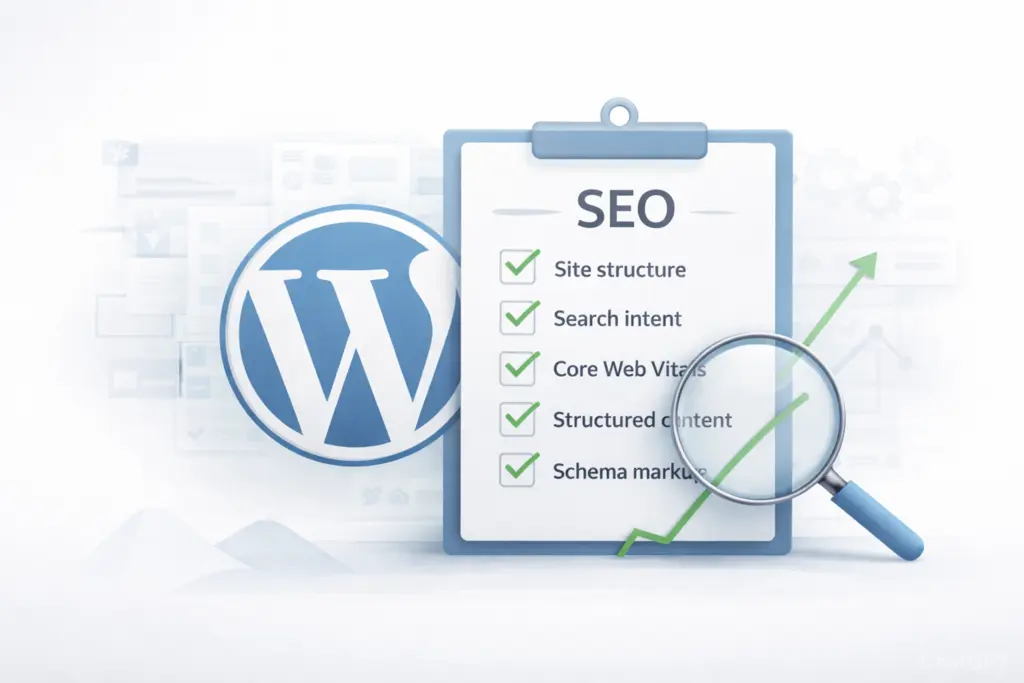
If your website still relies on “basic SEO best practices”, you’re already behind.
In 2026, SEO for WordPress websites is no longer only about keywords and plugins. It is about site architecture, performance, structured content, and real business signals.
This checklist is written for growing businesses and digital teams who want predictable organic traffic and qualified leads – not just rankings.
1. Start with a clean and scalable site structure
Before touching any SEO plugin, validate your content architecture.
Your structure should be:
-
clear for users
-
predictable for search engines
-
scalable for future content and landing pages
Checklist
-
One main topic = one logical content hub
-
Blog, services, use-cases and resources must be clearly separated
-
URLs follow a simple hierarchy
(example:/services/ai-integration/healthcare/)
Bad structure creates SEO debt that becomes extremely expensive to fix later.
2. Define search intent before writing content
In 2026, Google evaluates whether your page solves a real problem.
For every page, clearly define:
-
informational intent
-
commercial investigation intent
-
transactional intent
Checklist
-
one primary intent per page
-
supporting keywords must match the same intent
-
do not mix blog-style content with sales messaging on the same page
This is one of the most common reasons why business websites get traffic but no leads.
3. Build pages around topics, not single keywords
Single-keyword targeting is outdated.
Instead, build pages around:
-
one core topic
-
multiple semantically related subtopics
Checklist
-
main keyword in the title and H1
-
related terms naturally used inside H2–H3 sections
-
internal links between related articles and service pages
4. Fix your heading structure (H1–H6)
A surprisingly large number of WordPress themes still break heading logic.
Checklist
-
only one H1 per page
-
H2 used only as direct children of H1
-
do not skip heading levels
-
avoid using headings purely for styling
This helps both accessibility and search engines understand your content hierarchy.
5. Make Core Web Vitals a business KPI
In 2026, performance directly affects:
-
crawl efficiency
-
user engagement
-
conversions
Checklist
-
LCP under 2.5s
-
CLS under 0.1
-
INP within recommended thresholds
-
no heavy page builders on performance-critical landing pages
-
fonts and images properly preloaded
If your marketing team creates landing pages that ignore performance, SEO and paid traffic efficiency both drop.
6. Optimize images properly (not only with plugins)
Most WordPress sites still ship unoptimized images.
Checklist
-
correct image dimensions in markup
-
modern formats (WebP or AVIF)
-
descriptive alt text written for humans
-
no decorative images with meaningless alt attributes
Large hero images on blog and category pages are often the biggest performance bottleneck.
7. Use structured content, not only visual layouts
This is where many WordPress sites fail.
If your content is created only visually (for example, through drag-and-drop layouts), it becomes difficult to:
-
reuse content
-
scale content types
-
generate rich structured data
Checklist
-
clearly defined content types (articles, case studies, solutions, resources)
-
structured fields for key information (author, industry, services, results, dates)
-
consistent templates for each content type
Structured content is one of the strongest long-term SEO advantages.
8. Implement schema markup intentionally
Schema is not about installing a plugin and forgetting it.
Checklist
-
Article schema for blog posts
-
Organization schema for your company
-
Service or Product schema for service pages
-
FAQ schema only when the content genuinely answers questions
Schema helps search engines understand your business context, not just your text.
9. Fix internal linking at scale
Internal links define how authority flows through your website.
Checklist
-
every important page must have multiple contextual internal links
-
blog articles should link to relevant services
-
hub pages should link down to supporting articles
-
orphan pages must be eliminated
Internal linking is one of the highest-impact SEO actions you can control.
10. Optimize titles and meta descriptions for humans
In 2026, CTR is a major indirect ranking factor.
Checklist
-
titles clearly express business value
-
no keyword stuffing
-
unique titles for every page
-
meta descriptions written as short sales messages
Ranking without clicks is wasted effort.
11. Eliminate thin and overlapping pages
Large WordPress sites often accumulate SEO noise.
Checklist
-
merge overlapping articles
-
remove outdated or low-value pages
-
redirect replaced content properly
-
consolidate multiple short posts into authoritative guides
Content consolidation is often more effective than producing new content.
12. Control crawl budget on large sites
If your website grows, crawl budget becomes a real limitation.
Checklist
-
block unnecessary archives and filters
-
no indexation of internal search pages
-
no duplicate paginated content indexed
-
clean sitemap structure
Use Google Search Console (by Google) to monitor crawl behavior and index coverage.
13. Create business-driven content clusters
Do not build content only for traffic.
Build content for revenue.
Checklist
-
each content cluster must support one commercial service
-
articles must reference real business problems
-
include internal calls to action to relevant solutions
This is how organic traffic becomes a lead generation channel.
14. Optimize for E-E-A-T signals
Experience, expertise and trust are critical in 2026.
Checklist
-
real authors with bios
-
visible company information
-
real case studies and results
-
transparent service descriptions
-
clear contact and legal pages
For B2B websites, trust signals directly influence rankings and conversions.
15. Make conversion tracking part of SEO
SEO without conversion data is incomplete.
Checklist
-
track form submissions
-
track qualified lead events
-
separate blog engagement from business conversions
-
analyze which content actually produces leads
This allows you to prioritize content that generates revenue, not only traffic.
16. Prepare your content for AI-driven search
Search results increasingly combine classic results with AI summaries.
Checklist
-
clear definitions in content
-
concise explanations for key concepts
-
structured lists and tables
-
strong topical authority within clusters
Well-structured content is more likely to be referenced in AI-powered search experiences.
17. Avoid SEO shortcuts inside WordPress
Common mistakes that still hurt many websites:
Checklist
-
heavy page builders for complex layouts
-
bloated plugins duplicating functionality
-
multiple SEO plugins installed
-
visual hacks instead of proper markup
Long-term SEO stability depends on technical discipline.
18. Build SEO into your publishing workflow
SEO must be part of your content process, not an afterthought.
Checklist
-
content brief includes target intent and internal links
-
headings planned before writing
-
structured fields filled for every article
-
post-publish review for performance and linking
This dramatically improves content consistency.
Final takeaway
In 2026, successful WordPress SEO is not about tools.
It is about:
-
clean architecture
-
structured content
-
performance discipline
-
and strong alignment between content and business goals
If your website is built only to look good, it will struggle to compete.
If your website is built as a structured, scalable platform – it becomes a sustainable lead engine.
Check out How to build an AI-native WordPress website to improve your lead generation even futher!
Planning a custom WordPress website or redesign?
Avoid SEO mistakes before they become expensive.
Trending articles
Ukraine vs Poland vs Balkans: Where to Hire the Best WordPress Developers in 2026
Why Eastern Europe Is the Smartest Place to Hire a WordPress Agency in 2026
Funnel Flattening: How Modern WooCommerce Stores Remove Checkout Friction

AI-Powered WooCommerce: How Smart Personalization Increases Conversions
╳
We`d love
to hear
from you
to hear
from you
Get a Best Project Consultation
Congratulations!
Message sent successfully!